My take on mentors:
They choose you; you don’t choose them.
And here’s a 9-minute video that makes that case.
You can take my take…or leave it…but if you send a cold email to one of your marketing heroes asking them to mentor you, keep your expectations low.
Not because your heroes are mean…but they are busy.
I am never mean when I receive a request from a subscriber asking me to be their mentor.
I just send the video above…and try to turn it into a teaching moment.
But I don’t need to teach you. 🙂
I received one of those emails this week, and my thoughts turned to March of 2020.
Because it has been six years almost to the day when COVID took over our lives–and I went to my archives from that chaotic period and dug up a few things related to mentors and how we get to where we are in our careers.
After all, 2020 was the beginning of a year of concentrated thinking time.
In a mask.
With social distancing.
Thank goodness there was no masking or distancing from thinking.
One of the things that popped into my COVID infected brain at that time were all the friends, colleagues and soon-to-be mentors from a charmed career for which I am grateful.
But not being able to see them in person was painful…and got me wondering:
“How did I gather so many friends, colleagues and mentors.”
I wasn’t collecting them for sport…or for bragging rights about having so many.
No scraping Facebook “likes” for me. 🙂
As I shared just a few weeks ago, the toughest part of writing my book Overdeliver was when I got to writing the acknowledgements and realized I had over 500 people to thank…and I still missed some.
I hope you took me up on my challenge to write the acknowledgements for your book, even if you never intend to write a book.
While most of the 500 are still alive, thinking about all the greats of direct marketing we have lost makes me reflective and sometimes a bit melancholy.
And in 2020, being alone with my thoughts, it was even more melancholy thinking about lost friends and mentors.
Outliving mentors is nothing to complain about
This phenomenon (for me) was inevitable.
When I was in my 20’s and 30’s, I gravitated to folks in the direct marketing industry who were, I thought, “old” at the time—most were in their 60’s, 70’s (and even 80’s)—and of course my perspective regarding who is “old” is a lot different today.
Who says 68 is old??!!
Why did I gravitate to them over folks my own age?
It’s simple:
They had all the wisdom (which is not the same thing as knowledge).
It’s the difference between a “results leader” and a “thought leader” (a distinction I got from my good friend Joe Polish).
Anyone can have a thought; it takes a real leader with true wisdom to create results.
It’s hard to be a results leader when you are in your 20’s and 30’s (some marketing prodigies can do it) because you just haven’t had enough time to create a track record of solid results yet…and you also need time to create failures as well.
I was NOT one of those prodigies.
Susan Garrett, a good friend and a world champion dog agility trainer, says:
We win or we learn. We never fail.
So…I’ll correct myself:
You need time to create successes and learning moments.
The benefits are obvious when you learn from the best practitioners who have much more experience than you.
However, the downside is obvious when you gravitate towards wisdom this way as I explained above (i.e. you will outlive many of your teachers and mentors).
But not entirely.
If you pay very close attention to everything you learn from them while they are alive…and continue to apply everything you learned from them long after they are gone…they, and their ideas (and wisdom) will never die.
And with AI in the picture, there is no excuse to ever lose them.
I’ve begun creating custom Bots (with the help of some amazing AI practitioners inside Titans Xcelerator and some of my “top 500,” loading up their genius…and I plan to do a lot more creation of friendly Frankenstein monsters the future.
What about our living mentors?
In that spirit, I found a 4-way interview with three of my most treasured mentors who are still with us—alive and kicking in a big way—and I have included that interview from 2020 which talks about how entrepreneurs create opportunity during times of crises.
It is timeless despite being inspired by a pandemic.
There is a link to it in the P.S., and I encourage you to watch it or listen to it.
The benefits of being educated by your elders and peers while they are alive and after they are dead (through their writings, archives and lessons) is priceless education.
We owe it to ourselves to keep our mentors alive for as long as we are alive…and pass everything on to keep the train moving.
And I hope that what goes around comes around.
That is, 45 years from now, someone might be reflective, melancholy (and maybe just a little bit grateful) as they think about me not being around anymore either.
Or they will just think of me as a crotchety 113-year-old direct marketer worth ignoring. 🙂
But hopefully I can leave a footprint that can be applied long after I am gone.
It’s a math problem, this “losing your mentors thing” –especially if you insist on hanging out with old people when you are young.
If you are also intent on hanging out with young people (i.e. considerably younger than yourself) as you get older, hopefully you will see to it that you choose some exquisite mentees…which will make it all worthwhile.
More on that in a minute.
Share, share…that’s fair
I want to continue to share as much as I can—everything I have learned from the legends who shaped my career (and the careers of thousands more in direct marketing) who are no longer with us.
And many that are older and still with us too.
That’s what www.OverdeliverBook.com is all about…it honors my dead mentors (Dick Benson, Gordon Grossman, Gene Schwartz, Marty Edelston. Joe Sugarman etc.) and the ones who are still with us (Gary Bencivenga, Dan Kennedy, Perry Marshall, Jay Abraham etc.)
I promised myself that this post was not going to be sad…so I am here to tell you that after almost seven decades above ground, getting old(er) doesn’t suck.
One of my mentors who is no longer with us, Marty Edelston, often said to me, to be sure that I had the right idea about aging:
“I love getting older since it means I am only getting smarter.”
And if he was still alive today to have this conversation with me (which I know he would), he would once again explain the difference between “68 years of experience” vs. “one year of experience for 68 years.”
Smarter means wisdom and not just smarts…and the wisdom is cumulative assuming you are a lifelong learner.
Marty was a lifelong learner, and he taught me to think that way too, which at its core means always having insatiable curiosity, always hanging out with people smarter (and often older) than yourself and never letting your ego get in the way of learning.
“Getting old doesn’t suck” is another way of saying how my first 45 years of experience will enable me to make even a bigger difference for my next 45 years.
And no matter how immortal you think you are, because you are young and strong, you tend to assume you have lots of time to make your mark; but it’s possible you may not have that luxury.
But don’t fret about that—you have no choice but to play “life is long” because it’s the only one you’ve got.
It’s foolish to think that you could have launched something “bigger” at a younger age—like Alexander Hamilton in the show Hamilton who, “…wrote like he was running out of time.”
You shouldn’t be completely complacent, but I don’t think that is a useful way to think about it.
If you continue to learn and grow and make all your wisdom cumulative, I am confident your future will be bigger than your past, no matter how long it lasts.
This reminds me of one of the great moments in U.S. presidential debates.
Ronald Reagan was asked whether his advanced age would be an issue in his second term as President–he was running against the more youthful Walter Mondale in 1984–and Reagan was 73 at the time.
His response to that question:
“I will not make age an issue of this campaign. I am not going to exploit, for political purposes, my opponent’s youth and inexperience”
Leaving the campsite in better shape than you found it
While too many of my mentors are dead, they all left much more than some insightful advice over the phone (and in some instances, a nice inheritance for their heirs).
Most left their best thinking for us to immerse ourselves in their life of work…if we are aggressive enough to look for it.
You can be less aggressive than ever before by just using Claude or ChatGPT…the lazy man’s way to wisdom…which I endorse. 🙂
Most of my mentors wrote or created a legacy with books, reports, memos, promotions, letters, videos…they not only did it and taught it but they documented it too.
And today it’s easier than ever to document your genius too.
I assume many of you are working on GPT’s which reflect everything in your personal archives…I am…or maybe you are creating a killer Bot loaded with decades of content.
Regardless, I implore you to write more, create videos, courses—anything to spread your cumulative wisdom.
I also believe that it is our moral responsibility to look for “lost classics” or “lost files” and bring them back to life so that future generations can share in the wisdom of the past—and to also create them ourselves at the same time.
Like I did, re-publishing Gene Schwartz’s lost classics Breakthrough Advertising and The Brilliance Breakthrough as a starting point…I went on to honor Bill Jayme with a collection of his lifetime of work…then publishing the archives of Jim Rutz.
And I’ve got many more legends to “document” set up in the queue.
Suggestions are welcome.
If you haven’t heard of any of those legends above, you just proved my point and why we all should find these gems that will become foundational to everything we do in marketing today.
Yes, even with AI taking over the world.
So, I will ask you:
Who (what) can you bring back to life for the next generation?
And:
What can YOU create today, not from one of the greatest, but from your own cumulative wisdom, that will stand for generations to come?
Doing both are worthwhile endeavors.
On currently being the oldest in the room
The fact that I am often the oldest person (by chronological age) in many of the rooms I hang out in these days—hanging out with some of the most phenomenal and dynamic marketers in the world—is something I am proud of and I no longer make jokes about everyone in the room being young enough to be one of my kids.
A healthier perspective:
I am getting my Ph.D. in areas of marketing from others who may not have put in the hours (yet)… but they have achieved expertise way beyond what I know in one marketing discipline or another.
And maybe some context from my past could give them some new insights too.
Most importantly it’s good enough to grant me a golden ticket into those rooms whether I deserve it or not.
In the words of Aaron Burr in Hamilton (a show worth two quotes today):
“I want to be in the room where it happens.”
Be a sponge
I attended my daughter’s graduate school graduation in 2018, and it warmed my heart that there was a healthy mix of 25-year-olds and 65-year-olds receiving advanced diplomas in all areas of study.
And they, like everyone in our world of marketing, are best served when they are sponges for learning every step of the way, at every age, throughout their entire lives.
It can be through college or the school of hard knocks or learning from mentors.
There are many roads to mastery.
Education (and learning) is everywhere…and whether it’s in a classroom, a boardroom, a book, or a memory…document it…and pass it on.
Warmly,
Brian
P.S. In 2020, it seemed like every headline, subject line, podcast, launch led with some variation of “marketing and pivoting through the crises” …with “pivot” being the word of the year.
But entrepreneurs are always pivoting…in good times and bad…and the pandemic was no exception.
At the time I called the phenomenon a “Perpetual Pivot.”
Not being tone deaf at the time but knowing that we had gotten through tough times before, I was confident that we would get through this one.
Mission accomplished.
We came out the other end bigger and stronger than ever before.
And if you are not familiar with Dan Sullivan’s brilliant “4 C’s framework” from Strategic Coach (Dan is the top coach for entrepreneurs in the world), it was front and center during the pandemic…creating maximum growth and achievement.
Here it is (courtesy of Claude) if you are not familiar with it…and I suggest you copy it and pin it somewhere where you can read it every day:
- Commitment — Making a clear decision to pursue a goal, even before you know how to achieve it. This is the starting point where you declare your intention.
- Courage — Taking action despite fear or uncertainty. Once you’ve committed, courage is what moves you forward into the unknown. [NOTE: Per Dan, “Courage is a shi**y place”] 🙂
- Capability — The skills and abilities you develop as a result of taking courageous action. Capability comes after action, not before.
- Confidence — The deep, earned confidence that grows from having built real capability. It’s retrospective — built from past experiences of overcoming challenges. And now you are prepared for your next Commitment.
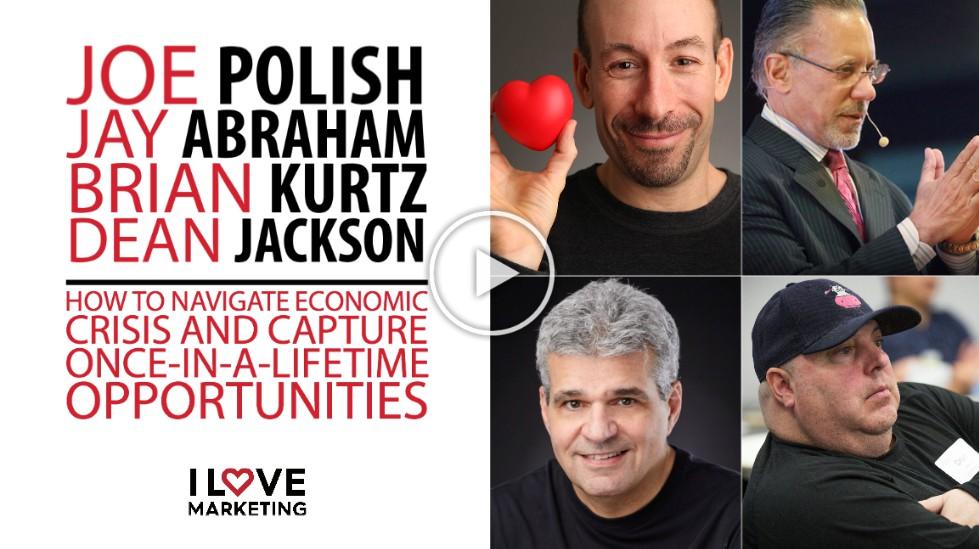
Right in the middle of the COVID mess, I got together with buddies and mentors Joe Polish, Jay Abraham and Dean Jackson and we hit the record button…and the title of it says it all:
“How to Navigate Economic Crises and Capture Once-In-A-Lifetime Opportunities”
It’s the ultimate “lemonade from lemons” video…with lots of Courage…and I hope you will watch it.
Just click on the play button below.