


When I was a senior in college, I was in the Honors Program in English (and that’s not “English as a second language”) 🙂
I’m both proud of that and a little embarrassed…because I was far from a scholar in English (or any) literature…and while most of the students in the class were doing their senior thesis on Chaucer, Milton or Shakespeare, I had other ideas.
My thesis was:
The works of Nathaniel West and their relationship to the films of Frank Capra in the 1930’s and 40’s
That wasn’t the exact title but it was close…I had no time for Milton and his friends…but then again, the Rutgers English Department had little time for me as well.
More on that in a minute.
Those of you who are unaware of either Nathaniel West or Frank Capra, here’s a quick capsule on each:
West was a somewhat obscure but influential writer during that period of the 20th century who wrote only 4 novels, the most well-known being The Day of the Locust and Miss Lonleyhearts.
He had a decent following but not a “classical” one among scholars (understatement).
And Frank Capra was one of the most prolific film directors ever (during a similar time period).
He swept the Academy Awards in 1934 with It Happened One Night and directed everyone’s Christmas favorite, It’s a Wonderful Life– among many others.
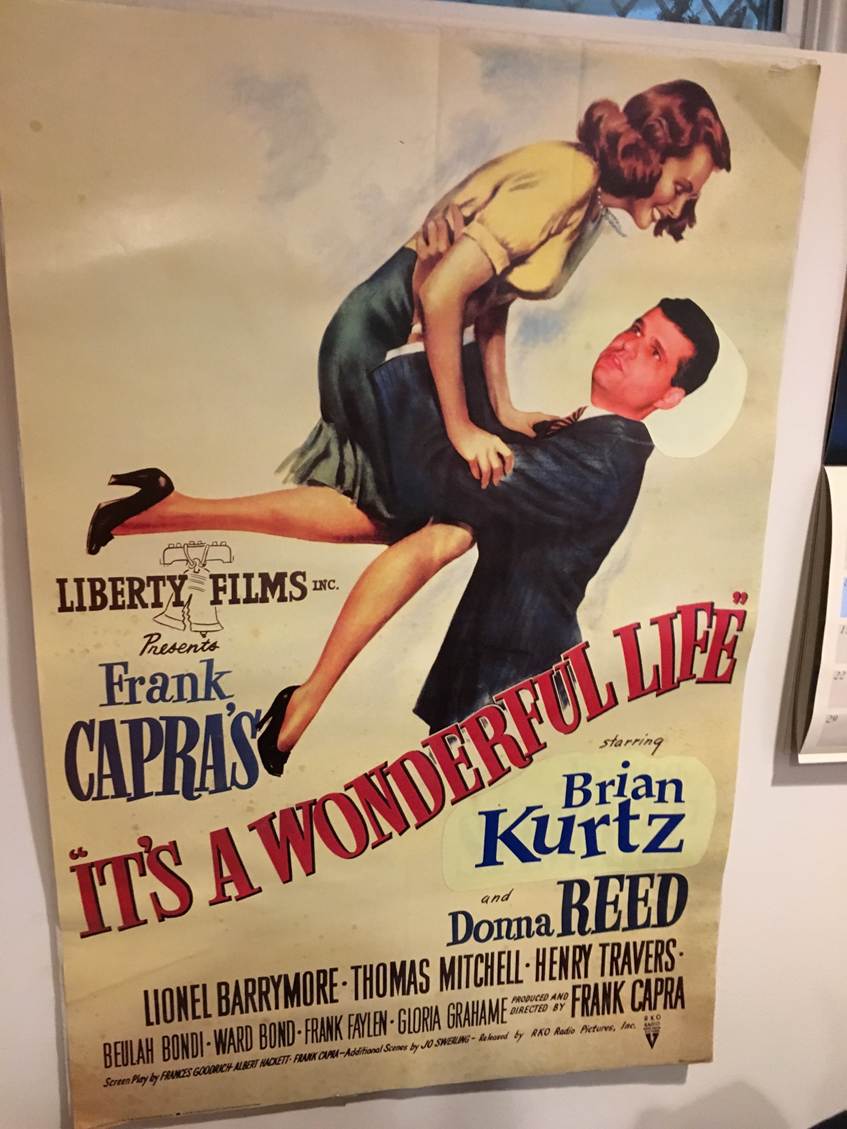
Here’s a poster that sits behind me in my office—note the personalization which was done for me by a good friend:
Also note: The great Ben Settle and I did a webinar (at the beginning of COVID in March of 2020, when movies were all we had).
It was a discussion about the films of Frank Capra and what we can learn from them in terms of direct response copy and marketing.
I can safely say this discussion is far more illuminating (and entertaining) than my college thesis…albeit, that’s a low bar. 🙁
I only wish I had Ben at my side in college…and I knew something about direct response marketing back then too. 🙂
Ben is also a super fan of Capra.
Click here if you are interested in watching the replay.
We had a blast.
Why am I telling you all of this about my college thesis and other random thoughts?
To make the distinction between being “anxious” and “eager.”
Back to my senior thesis.
After I handed it in, with much trepidation, I saw the chairman of the English Department (his honor, Dr. David Kalstone) in the hallway—around the time the “committee” (with him at the helm) was discussing my paper.
I stopped him and said:
“I’m anxious to hear what you think of my thesis—it’s the one about West and Capra.”
To which he replied:
“Ah yes. That one.“
He went on:
“I presume you mean you are eager rather than anxious…but you should be anxious.”
He was mostly right…I was eager AND anxious, not realizing I stumbled into a valuable semantics lesson that stays with me to this day:
I never use the word anxious when I mean eager. And vice versa.
But that doesn’t mean I don’t have anxiety (and some dread) like many of you–as entrepreneurs, marketers and copywriters as a natural occurrence.
And I experience eagerness often as well…but I like to separate the two emotions…especially when I am on the battlefields of the marketing wars I have experienced over 45+ years.
It creates a sanity check for me (i.e. it keeps me from getting too low or too high before, during and after every test or campaign I have run).
What Dr. Kalstone was trying to tell me that day was that my thesis was not up to snuff compared with the other true English scholars in the Honors Program…and while I received the lowest level of honors on that offbeat paper, I was never bothered about how it was viewed or graded.
But it was foreshadowing of a sea change as I entered my career in direct marketing where I would have to care about the “grade” (i.e. response) all the time.
College is not reality: I had written what I wanted to write about with no one else telling me what to do.
Very freeing.
But that was about to change.
Shortly after leaving Rutgers and entering the world of direct marketing, it mattered a lot what others thought, namely customers and prospects.
The best thing I got from that experience in college, as it pertains to direct marketing, is that whether I am anxious or eager about a marketing campaign, advice I give to a client or even when I write this blog every week, objective and measurable results are what matter.
Period.
Or…as I say often (in the words of Joe Polish), I am a results leader not a thought leader.
“Anyone can have a thought. Not everyone creates results.”
And I imagine many of you would much rather be results leaders too.
I’m reminded about an example from my career where I should have been more anxious than eager.
Or at least eager with guardrails.
After our initial infomercial success at Boardroom in 2015—where we made in excess of $200 million over 3 or 4 years—and much more with all the multi-channel marketing we did around the campaigns—I was eager to try many more shows after 3 out of our first 4 worked (when we were told that one out of 15 or 20 was the average success rate).
I didn’t listen to the experts who opined that our success was more beginner’s luck than pure genius (although those early shows were genius) …and we plowed ahead with one new show after another—believing I had some super power—only to have one failure after another.
You might say the odds caught up with us in a big way…and below is an observation from my book, Overdeliver, chapter 3, on How Paying Postage Made Me a Better Marketer:
We learned a lot of valuable lessons from those shows that did not work.
The biggest lesson is that if you don’t approach every direct response campaign with discipline and objective standards, you’re dead in the water.
[Unbridled eagerness vs. realistic anxiety?]
Having the privilege of working with the best marketers in the world at Boardroom (inside and outside) made it almost worthwhile to have some shows not be as successful or campaigns that fell short so that I (we) could learn from them and come out even better the next time.
But we had read our own press clippings on the first four and thought we had this medium nailed.
Discipline is what made the direct mail generation of marketers so successful.
Every single campaign sent through the United States Postal Service had to be meticulously researched and planned so that nothing was wasted.
Every test had to mean something.
Every test needed to light the path to a potential breakthrough and a new control package.
And if not, you can’t keep trying the same thing over and over again.
Direct mail marketers are always testing new approaches against the control to find the next winner.
I knew this instinctively but failed to follow my own advice.
The best online marketers today think about testing the same way—that’s why they are the best online marketers today.
They also know that selling so easily and cheaply online is an opportunity that should be used and not abused, given that it’s unlikely you’ll have to pay postage anytime soon.
I remember an urban legend in the early days of the internet that postage was going to be assessed for every email—it was a made-up story—but I have to admit that creating a tougher barrier to entry for anyone and everyone to use email kind of intrigued me as a marketer who knew how to pay postage and make money.
My fantasy was that this would perhaps weed out the impostors.
As we know, that did not happen.
But when you truly understand that there is a huge cost to send marketing messages that are inappropriate, not targeted, and lack discipline, maybe you will see the light.
Not you (the reader of this book).
Other people. 🙂
Their sloppiness hurts all of us.
Simply put, the best marketers in any medium know that waste sucks and discipline isn’t just something for the folks who pay postage.
It benefits every marketer, no matter whether you’re using e-mail, TV, radio, affiliates, or pay-per-click advertising.
The fact that you don’t have to pay for postage to send your online marketing messages is not a license to beat your list into submission until they buy.
My conclusion?
For principled issues you will not compromise on (or when writing an occasional English paper), not caring about results, as long as you are comfortable and consistent with your beliefs, may be OK.
You may be anxious about the results but that won’t be the key metric.
It will be that you expressed yourself fully.
For direct marketers, you have to be principled too…but you also have to make a profit.
And when you can call a loser early (maybe even before you go out with it through research–a topic for another day), you can get back on the horse and deliver something the market wants and not something you fell in love with…and you thought everyone else would fall in love with it too.
You will be anxious about the results here as well (which is fine) …but also eager to learn whether it worked or it didn’t…and where to go next.
Warmly,
Brian
P.S. Read This or Die: The Lost Files of Jim Rutz, is a product I am incredibly proud of and one that has gotten great reviews from hundreds of buyers (with no returns).
Jim Rutz was one of the greatest copywriters who has ever lived—one of the originators of the magalog (with Gary Bencivenga)…and he was as strange as he was brilliant.
More Nathaniel West than Frank Capra. 🙂
That’s what made his copy so compelling and unique.
Whether you order the product or not (I just ordered 100 more so we have them in inventory), I think you will enjoy the blog post I wrote about him.
Jim was as eager (I never remember him being anxious) as anyone to get the results on anything he ever wrote—he had some of the biggest winners and some of the biggest losers of all time—and he took each one in stride.
He also loved the “game” of direct mail which is why I think he was rarely anxious about his packages once they were mailed…because even with the big losers, he always knew he had another idea right behind that one.
And he could also make the big winners even better.